Saturday, October 1, 2011

Everyone dies.

Again. Othello and Desdemona dies. Just like Romeo and Juliet. And it's all about timing.


If only Desdemona frankly told Othello about her handkerchief. If only Othello pressed Iago for concrete evidence about Desdemona and Cassio's affair. If only Roderigo had been a little smarter. If only Cassio had noticed Othello's increasing dislike towards him.

Iago, Othello and Cassio.

Iago made Othello, Cassio and Roderigo look like complete idiots. Roderigo was killed by Iago after his unsuccessful attempt to kill Cassio to destroy evidence against him. After Othello smothered Desdemona in her bedsheets (very dramatic indeed), he kills himself after discovering that it was all Iago's deeds which led him to believe all that slander about Desdemona and Cassio. But who would expect that it was the soft-spoken Emilia, wife to Iago to save the day when she shed light on Iago's horrible plans and schemes. She became a martyr of feminism as even after Iago told her to 'shut up', she connected the dots and revealed that it was all a part of Iago's plans. Iago then stabs her for revealing too much.

Othello commits suicide.

Othello, poor Othello. At first, Othello was such a noble, brave, loving, confident and seemingly perfect general. Eventhough he was about to wed and consummate his marriage with Desdemona, he was willing to postpone it until after the war in Cyprus. He also reassures everyone that he will not be blinded by love and instead ensure a victorious battle against the Turks. But throughout the story, his character develops in such a way that all in all, it is revealed that Othello is mortal. He is a human and he is not perfect. He has his own flaws and with Iago's insinuation, he fell deeper and deeper into the little trap set by Iago. It was not wars, neither mortal injuries nor diseases which led of the downfall of a capable general; but it was jealousy which brought Othello to his knees (and his deathbed).

Desdemona strangled by Othello.

Desdemona has my heartfelt pity. Of all the emotional and physical abuse that Othello had showered on her, it was until before her tragic death she knew the reason behind all that treatment. She was smothered for something she know not of, and something that she did not do. It was slanders and jealously that killed divine Desdemona. The little speech she gave before she died revealed how much she loved Othello for she blamed no one but herself for her tragic death.
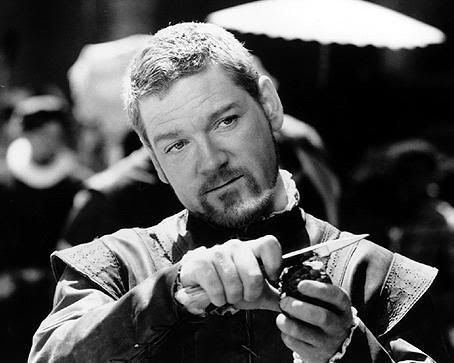
Iago


But I was very disappointed when Iago refused to speak anymore when all his evil schemes were discovered. After going through all Iago's meticulous plans to eliminate Cassio and Othello, I am still in the dark as to Iago's real motives. All the conversations Iago had with the audience, its credibility can be doubted as his manipulative nature is evident. He might have been manipulating, us, audience all along the play too. Why did he want to destroy the Moor? He hated Othello because he promoted Cassio instead of himself as a lieutenant. He felt that it was unfair as he certainly has the capability and experience to be a lieutenant, compared to Cassio who is all about books. He believed that Othello slept with Emilia. But then again, this is disputed because we know how manipulative Iago is and we simply do not know whether he intentionally made this up in his mind so that he has an excuse to eliminate the Moor. His main objective was to cast aside Cassio but in the process, he eliminated so many more people in the way.

Cassio lamenting about the importance of reputation to Iago.

And Iago is so much smarter than Othello. He is by far, the smartest character in the play, second to none. (Perhaps Emilia could come close but her sudden revelation was too late to aid the situation.) But Iago's strategy seem almost plausible at some points. Firstly, I think that it was pure luck that Emilia obtained the handkerchief. It is not everyday that Desdemona drops/loses her handkerchief without noticing it. (It was in fact, Othello who dropped it.) When the handkerchief is dropped, Emilia suddenly tells us that Iago has often told her to steal the handkerchief for Emilia and she wanted to please him. Since Emilia knows that Desdemona prizes the handkerchief so much, why did she hand it to her husband first (for she certainly knows that Iago is definitely up to no good) instead of giving it back to Desdemona? Why is she craving for Iago's love and attention when she is so cryptical about men? And don't Othello know that he was the one who refused and dropped Desdemona's strawberry handkerchief that day? Secondly, Roderigo should know something is amiss when Desdemona paid no attention to him whatsoever eventhough Iago promised to help him. And when Roderigo finally got to his senses and decided to confront Iago, Iago puts Roderigo into action to kill Cassio. Roderigo's in the middle of shouting at Iago and then when Iago suddenly instructs him to kill Cassio, without any justifications, Roderigo agreed and went off. It also seems a little ludicrous (in today's context at least) to kill one's wife when Othello isn't even definitely sure that Desdemona cheated on him.


Lastly, why is this play called Othello when Iago is the mastermind behind this whole play? And what happens to Iago? Eventhough Lodorico promises that Iago would be dealt with accordingly (obviously to be prosecuted) but no more is revealed about Iago. That is upsetting because I would definitely what would happen to Iago after all the he has done.

But at the end of the day, I think Iago is still the winner eventhough his deeds were revealed anyway because he had mostly achieved what he wanted to. Othello is dead, Cassio is wounded, useless Roderigo and his rookies Desdemona and Emilia are all dead.

Jealous Othello.

Jealousy can be very viscous and dangerous- that's the message of this play. When I first read the first few acts, I was under the impression that Othello would be all about Race and Racism as there were many derogatory terms such as Moor and black when referring to Othello. But after reading all 5 acts, I can thus conclude that Othello is a powerful play about jealousy, manipulation, deception and murder.

Thursday, September 22, 2011

Othello Act 1-2

1. My opinions on the main characters.


Iago is very clever. As dangerous and as evil his plans are, I really like his character. He is also very racist as he refers to Othello as the 'black Moor' and anti-feminist as well. This is revealed through his conversation with Desdemona on how an ideal woman should be like. But he is highly skilled in manipulation tactics. He first did so with Roderigo, taking advantage of his undying love and affection for Desdemona, who was already Othello's wife. Iago used Roderigo to get things done, to provoke Cassio, to raise the alarm et cetra. And Cassio just falls into his trap perfectly. When all the damage is done, Iago deteriorated the situation by adding insult to the injury when telling Otello what had happened between Cassio and Montano. But he did so in such a discreet way that Cassio didn't even know that his career was just destroyed and teared apart by Iago. While Iago gave him advice for him to redeem himself (but actually just setting Cassio up for yet another downfall), Cassio whole-heartedly sought his advice and even thanked him. As he is the only character that directly addresses the audience, so he is a very appealing character to me.


Othello is somewhat the protagonist. In Act 1, he is noble and highly respected leader. His confidence and calmness were seen during the confrontation scene when Desdemona's father accused him of wooing her daughter with witchcraft. He also got his priorities right, which was to focus at the task at hand, to defeat the Turks at Cyprus. He seemed somewhat flawless in Act 1: a brave general, a loving husband, a peace-maker which made me feel as though he is rather fake and unbelievable. But his ratings drooped a little (for me at least) when he dismissed Cassio after listening to Iago's highly crafted speech. Cassio did not even have the chance to explain (but anyway he was too drunk). But then again, I cannot blame him for dismissing Cassio for Iago's just too clever. And then, it can be evidently seen in Act 2 that Othello is rather a soapy fellow to Desdemona. Too soapy, in my opinion, considering the fact that all the other male characters were anti-feminist. Desdemona is indeed the captain's captain.


I respected Cassio, I really did. Although his character was insulted right at the beginning of the play, I still found him a great character for he is a responsible lieutenant. Despite being insulted by Iago about his well-to-do family background a reason for his promotion to a lieutenant, I was under the impression that Cassio was a trustworthy and dependable character. However, I found his over the top apple-polishing a little annoying as he went on and on with the flattery which sounded like a broken tape recorder to me, just like Roderigo's whines. He also gave in to Iago's persuasion very easily for if he never drank, he wouldn't have fell into Iago's trap. But what done is done, for Iago is indeed a very persuasive character.


The one that has my sympathy is the poor Roderigo. Having failed to get Desdemona, he is being severely exploited by Iago with his schemes. And Roderigo, the poor fellow, is playing his part exactly like how Iago directed him to. Iago is the director, while Roderigo is the actor. Or you can say Iago is the puppet master and so forth.


2. My thoughts on the storyline.
So far, the storyline has been pleasant and fast-paced. From Act 1 to 2, Iago's great evil schemes begin to unravel and it enlightens me a lot about the fact that I know all about Iago's plans. The most clever part of the storyline is that the audience are actually one of the characters of the play as well so it makes readers, like me feel involved. And Shakespeare, or rather Iago, does not treat us, readers completely stupid people. Iago challenges and convinces us that he is not exactly a villain and tries to justify it. Here, Iago also tries to manipulate us, the readers. And the fact that we know all about Iago's schemes makes readers on par with Iago, in other words, as smart as Iago, makes us feel very good, for we are respected and also are as intelligent as Iago. The storyline up to Act 2 is simple enough but I have this feeling that the plot is about to get more exciting and more complex as it progresses through Acts 3 to 5.

Feedback.

1. What I found useful?


- Acting out our parts
I found this particularly useful because when I took on different characters, their motives and characteristics becomes more evident and clearer to me. Before that, while I was doing some light reading on Othello, I just went through it like how I normally read books. But as Mr Martin said, plays are supposed to be acted out. So when it is actually acted out, it made so much more sense, compared to reading it on my own. I guess the magic is being involved in the progression of the play.


- The Circle
Group discussion indeed work wonders. As we moved through the play, we got to discuss the progression as well as the development of the characters as they become more 3 dimensional. Also, I got to hear other people's opinions about the plot/ characters which some were rather interesting. Some have also mentioned pointers that I have never thought of before. So this also allowed me to view the play in different perspectives. And somehow, this somehow allowed more justifications to be made about characters like Iago's manipulative nature and Roderigo's wimpy and whiny character.


- Close text analysis sessions
This made me realised I had missed out quite a lot when reading/ acting out Othello. During these sessions, it is then that I see what a genius Shakespeare is: his clever use or 'play' of words as well as telling this story through his characters. I particularly like analysing Iago's lines because it reveals a lot about his manipulative personality. And Shakespeare does it ever so discreetly in Iago's line so even after he has manipulated a character and us, the audience, sometimes it isn't surprising to find that we have actually been maneuvered around, dancing to Iago's little merry tune.


- Presentations
This method of allowing one group to be in charge of one certain aspect and then teaching it to the remainder of the class saves a lot of time. As our presentations have shown, this method is quite interactive as well. Besides ensuring that each student knows about what is presented, it also allows me to relate the information given back to the play, like how we did with Othello and Racism.


2. What do I like to do instead?
Well, I am actually quite comfortable with the current way of learning. But of course, I am open to any new and interesting ideas to spice up our way of reading/ learning Othello.

Nicole.